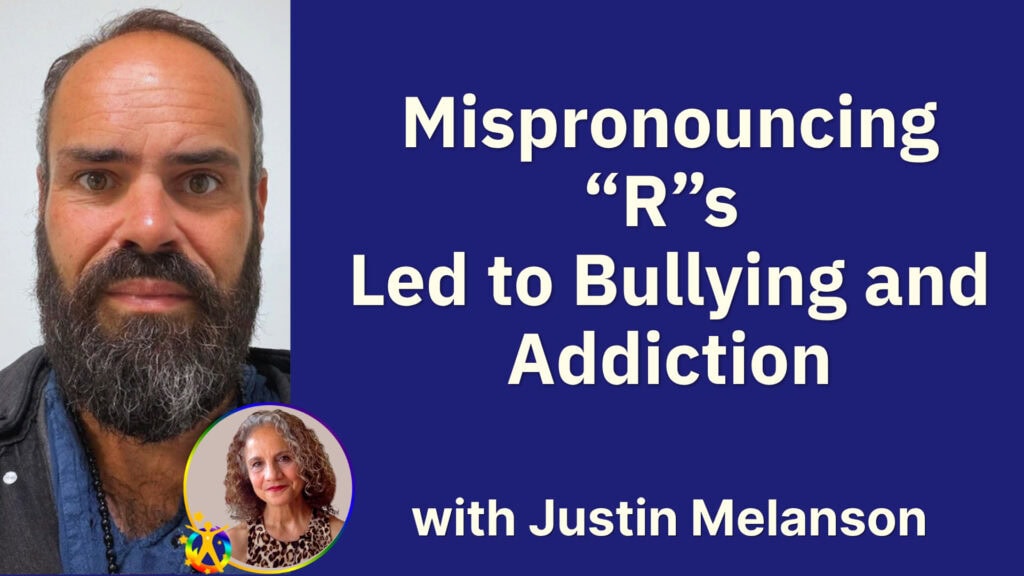
A speech impediment in childhood can affect far more than pronunciation. For Justin Melanson, difficulty pronouncing the letter “R” became the starting point for years of bullying, declining school performance, isolation, substance use, and trauma. His story also shows how meaningful relationships, purposeful work, recovery communities, and creative expression can help someone rebuild a life.
In a conversation with Mina Roustayi, Justin Melanson described how early experiences at school followed him into adulthood, including his military career and struggles with alcohol and drugs.
How a Speech Impediment Led to Bullying
Justin Melanson first received speech support around Grade 5 or 6. He worked with a speech therapist because he had difficulty pronouncing his “R” sounds. He gave the example of saying “wastewack” instead of “racetrack.”
At first, he didn’t consider the speech difference serious enough to invest significant effort in correcting it. That changed in Grade 7, when he was asked to read aloud in class. One student laughed at his pronunciation, followed by more classmates. Soon, much of the class was laughing.
That moment marked a major change in his school experience. Justin Melanson went from being a popular class clown with strong marks to being bullied, pushed around, and mocked. Reading aloud became a source of intense fear because he expected another humiliating experience.
He described the emotional response physically, saying the fear felt like “an overwhelming amount of butterflies” in his stomach and “battery acid” in his veins. The bullying affected how he viewed himself. He felt that he had gone from being worthwhile to being worthless.
The Impact of Bullying on Learning and Self-Esteem
The bullying affected both Justin Melanson’s academic performance and his relationship with his parents. His parents had been proud of his school results, but when his marks began to decline, their concern often led to punishment rather than support.
Justin Melanson tried to explain that he was being bullied. Although people believed that the bullying was happening, he felt they did not understand how closely the harassment was connected to his dropping self-esteem and worsening grades.
Over time, school changed from a place where he enjoyed learning and socializing into something he wanted to escape. The experience illustrates why educators and parents need to look beyond academic results. A sudden decline in grades may be connected to bullying, fear, shame, social isolation, or a student’s sense of safety.
How Justin Melanson Practiced His Speech
Despite the emotional damage caused by bullying, Justin Melanson eventually used the speech lessons he had received to work on his pronunciation independently.
He used a small cassette recorder to listen to himself speak and practice the “R” sound. He focused on placing his tongue correctly and repeated the exercise over and over. He described the process as slow and difficult, but eventually he learned to pronounce the sound.
This experience shaped the way he later understood adversity. Rather than viewing the people who mocked him only as harmful, he began to think about whether he could use the experience as motivation to improve himself. That perspective did not erase the harm caused by bullying, but it helped him transform part of the experience into personal growth.
Why Justin Melanson Left High School
By high school, Justin Melanson had a friend group and played music, but life at home remained difficult. He was often punished when his marks were not high enough and rarely encouraged when he was doing well. He spent much of his time isolated in his bedroom.
His first job at McDonald’s became an important turning point. The work gave him motivation, structure, teamwork, and a sense that he mattered to a group. It also helped him develop a work ethic and confidence.
When he began earning enough money, he decided that he needed to leave home. Working full-time while finishing school felt too heavy, so he left school with the possibility of returning later. For Justin Melanson, leaving was connected to his immediate need for safety and independence rather than a lack of ability to learn.
Substance Use as a Response to Emotional Pain
Justin Melanson began drinking at age 15. He described living in a home where there were hundreds of bottles of homemade wine. Although he disliked the taste, alcohol created a warm feeling that he experienced as a comforting hug.
That sense of comfort became a way to cope with loneliness, punishment, lack of privacy, and emotional pain. He also used cannabis and, when available, prescription opioids taken from someone else’s supply.
Later, substance use returned during his military career. At first, Justin Melanson associated drinking and drugs with having fun and fitting into the drinking culture around him. After returning from a six-month deployment to Afghanistan, he began drinking every day and used the length of his deployment as a reason to justify it.
Eventually, alcohol became necessary for him to function at work. During shifts in North Bay, he sometimes brought a bottle containing vodka mixed with water so he could control the shaking in his voice. Because his job required him to speak over an intercom to a large operations floor, the physical symptoms of withdrawal reminded him of the humiliation he had experienced when classmates mocked his speech.
Recovery Required a Personal Commitment
Justin Melanson first sought therapy in 2014, when he was preparing to become a father. He recognized that he needed to change, but initially tried to recover for other people rather than for himself.
He went to rehabilitation three times. The third time, during the beginning of the COVID-19 pandemic, he realized that lasting recovery had to be his own decision. That commitment helped him remain free from alcohol and drugs for seven months, although he later relapsed.
He connected the relapse to isolation, unresolved emotions, and returning to an environment that reminded him of childhood trauma. After swallowing alcohol-containing mouthwash during an emotionally charged moment, he quickly returned to drinking.
Alcoholics Anonymous eventually provided the social connection and structure he had been missing. Through meetings, service work, and leadership in his local group, Justin Melanson found a sense of family and importance. Helping others also helped him recognize and address his own struggles.
Social Support and Creative Work
More recently, Justin Melanson experienced homelessness after heavier drug use, the loss of housing, and problems with identification and banking access. He eventually moved from Moncton to Shediac, walking 30 kilometers with a backpack, clothing, books, and a guitar.
Support from veterans, a town councillor, an RCMP veteran, friends, and a veterans’ housing program helped him regain stability. He also became involved in sailing and received practical support with furniture and housing.
Today, Justin Melanson uses writing, music, athletics, and storytelling as alternatives to returning to drugs and alcohol. He described storytelling as a way to break out of the cycle because he can use his experiences to help others.
For Justin Melanson, recovery depends on making an active choice about how to use his freedom. He can use his time to develop his art, writing, and athletic interests, or return to hopeless thoughts and substance use. His current direction is shaped by connection, purpose, and the decision to keep moving forward.
What Educators and Parents Can Learn
The conversation between Mina Roustayi and Justin Melanson points to several important lessons:
- A speech or language difficulty can affect confidence, participation, and academic performance.
- Bullying may create long-term shame and fear around speaking, reading, and being noticed.
- Declining grades can signal emotional distress rather than a lack of ability.
- Punishment without understanding may deepen isolation and discourage communication.
- Social connection played a major role in Justin Melanson’s success at work, in the military, and in recovery.
- Addiction can begin as an attempt to manage emotional pain, loneliness, trauma, or withdrawal symptoms.
- Recovery was strengthened by structure, service, friendship, family-like support, and meaningful creative work.
- Students with speech differences need to be heard and supported before shame becomes part of their identity.
Justin Melanson’s experience shows how early school experiences can echo through adult life. It also shows that educational setbacks do not define a person’s ability to learn. With support, purpose, and a sense of belonging, people can develop skills that once seemed out of reach.
🌟 → Join the Free Panel Speech, Language, and Polyvagal Theory online event (Sat, Nov 14, 2026 ).