What is the polyvagal theory?
The polyvagal theory explains how the nervous system responds to cues of safety and danger. As Marty van der Rijden explains, the body continuously scans the environment, relationships, and internal sensations for signs of safety or unsafety.
When the nervous system detects safety, people can feel connected, trust themselves and others, think clearly, and stay open to learning. When the nervous system detects danger, the body automatically moves into a protective state. This can involve fighting, fleeing, freezing, shutting down, or becoming disconnected.
These reactions are not always conscious. The nervous system may respond before a person has time to think through what is happening.
My World turns nervous system states into a visual map
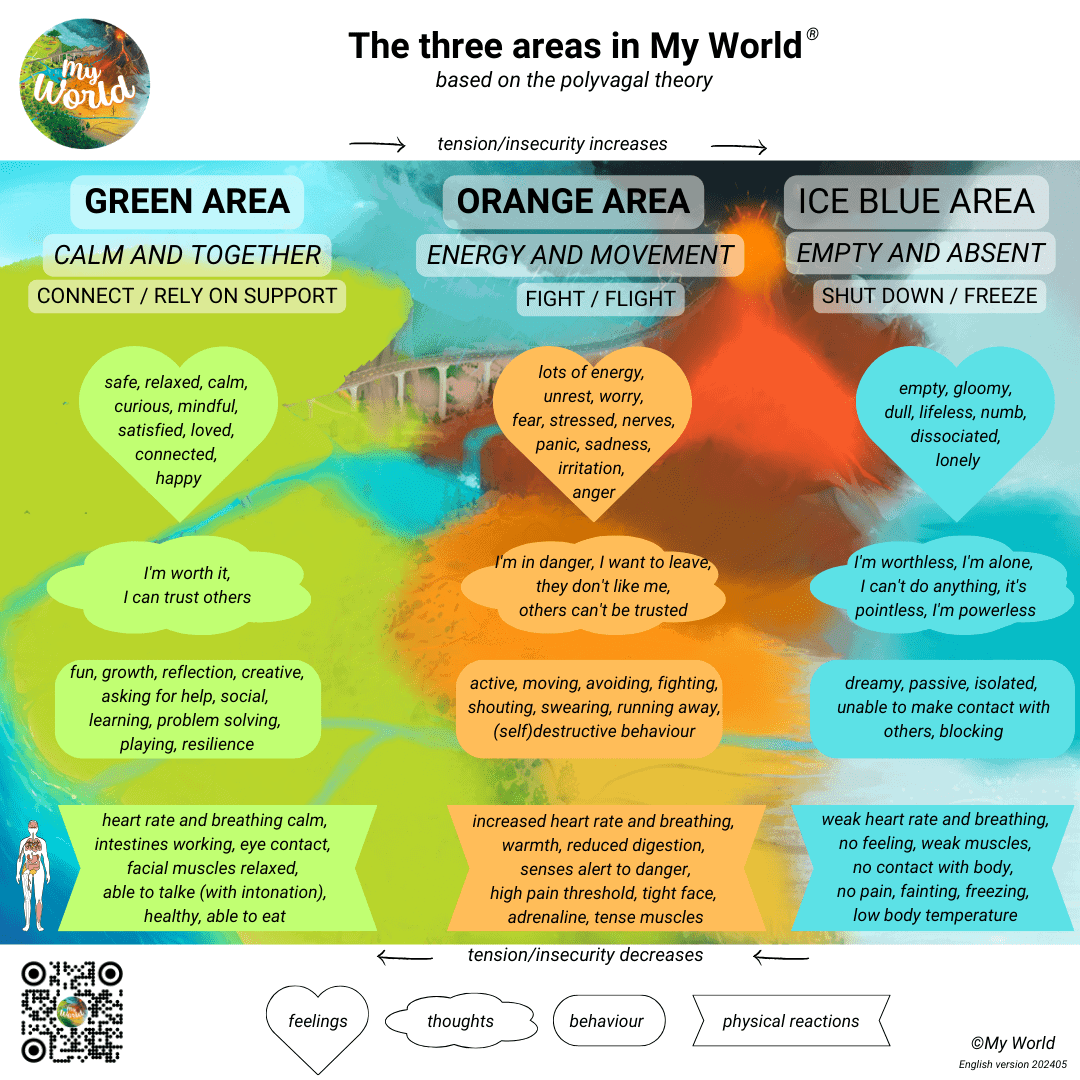
The My World map represents the inner world as a landscape with different areas. Each area reflects a nervous system state and includes visual symbols that make abstract psychological concepts easier to discuss.
The three main areas are:
- The green area of calm and connection
- The orange volcanic area of energy and movement
- The ice blue area of low energy, shutdown, and disconnection
The map gives children a way to communicate without needing a long explanation. A student can point to a location and say, “I’m here.” From there, an educator or parent can ask what the student needs and explore which resources may help.
Evelyn van der Kerkhove explains that the map also includes symbols connected to small exercises involving breathing, movement, the senses, and connection. These exercises help people become more aware of inner resources and notice signals of safety in the body.
The green area: calm, connection, and learning
The green area represents a state of calm and connection. The map includes images such as a campfire, a shared table, creative activities, music, sport, yoga, and a beach.
According to Marty van der Rijden, people in the green area can think, plan, stay curious, and learn more easily. This makes the state especially important in schools. A child who feels safe and connected has more access to attention, curiosity, communication, and development.
The green area also supports co-regulation. Connection with another person can help the nervous system return to safety. This is why a regulated teacher, parent, or therapist can play an important role when a child is overwhelmed.
The orange area: fight, flight, and intense energy
The orange area represents energy and movement. In polyvagal terms, this relates to the sympathetic nervous system and protective responses such as fighting or fleeing.
Evelyn van der Kerkhove describes how a child may move slowly through the orange area, becoming irritated, confused, or mentally disorganized. In other situations, the nervous system may take what the map calls a “highway” directly to the volcano. A sudden event can trigger an intense reaction in less than a second.
Marty van der Rijden notes that some children can appear to go from zero to 200 immediately. The nervous system may interpret an event as dangerous, even when the situation does not appear objectively dangerous to an adult.
This can result in hitting, kicking, throwing objects, shouting, or other explosive behavior. The behavior is visible, but the nervous system response underneath it may be harder to see.
Why children may seem to “live on a volcano”
Some children experience prolonged stress or repeated feelings of unsafety. Evelyn van der Kerkhove recalls children in practice saying, “I live on a volcano.”
The My World approach does not treat this reaction as something shameful or forbidden. A child may have very good reasons for spending a great deal of time in a protective state. Punishment can add more shame and unsafety without addressing the nervous system response.
Instead, the map helps adults explain that the reaction is understandable and protective. The goal is to invite children to explore other areas of the map and experience small moments of safety, rather than demanding an immediate change in behavior.
As Marty van der Rijden explains, behavior can be understood as an outcome of how the nervous system feels inside. This perspective creates a different response from punishment or rigid control. Once adults understand the protective state, adults can focus on helping a child feel safe again.
The ice blue area: shutdown and disconnection
The ice blue area represents a protective state with very little energy. Marty van der Rijden describes it as a state in which a person may feel empty, absent, lonely, or helpless. In polyvagal terms, this corresponds to the dorsal state.
Evelyn van der Kerkhove adds that people in this area may feel disconnected from themselves and from other people. Returning directly to the green area can be difficult because the body may need to rebuild energy gradually.
The map presents safer and less safe routes. Gentle movement, pleasant sensory input, and small increases in energy can help a person move slowly toward connection. By contrast, some people may seek intense or harmful ways to escape shutdown. The conversation mentions substance use, alcohol, and self-harm as unsafe routes that may appear on the map.
The orange and ice blue cycle
Some people move repeatedly between high energy and shutdown. Evelyn van der Kerkhove describes a cycle in which a person searches for more energy, becomes overwhelmed by that energy, and then returns to the ice blue state feeling guilty, sad, disappointed, or disconnected.
This model can reduce the belief that a hidden “saboteur” is causing the problem. The pattern may be a nervous system loop. Understanding the loop can make room for hope because a person can learn to recognize triggers, identify resources, and practice safer routes.
How the My World board game works
The My World board game uses the same visual map. Players roll a die and move a pawn across stepping stones. Some spaces connect to short exercises that involve:
- Breathing
- Movement
- The senses
- Social connection
- Awareness of inner resources
One example asks players to move their hands for a minute while another person mirrors the movement. The activity combines movement, attention, laughter, and engagement.
Another exercise involves taking a slow breath out as if blowing away a dandelion. The activity gives players a simple way to practice breathing when a situation cannot immediately be changed.
The game makes nervous system education practical. Players learn about the concepts while experiencing small exercises that may help the body recognize safety.
Why the map can help schools and teachers
The My World approach offers schools a shared language for discussing emotions, behavior, stress, and regulation. A student can identify a location on the map without having to explain every detail verbally.
The approach also includes the teacher’s nervous system. Evelyn van der Kerkhove explains that the school program helps teachers notice personal nervous system reactions and practice self-regulation. This matters because teachers often manage heavy workloads and difficult situations.
A regulated teacher can help a child in the orange or ice blue area find a safer route back toward calm and connection. Children may not be able to complete that process alone. Co-regulation gives children support while self-regulation skills are still developing.
Safety needs to be felt, not only understood
Knowing the terminology of the polyvagal theory is useful, but Marty van der Rijden emphasizes that safety also needs to be experienced in the body.
The exercises and playful activities create opportunities to feel calm, connection, and regulation. For children with a very small green area, repeated moments of safety can gradually expand the ability to access that state.
My World brings together visual learning, movement, play, communication, and nervous system education. The result is a practical framework for helping children and adults understand what happens inside the body, respond to behavior with more compassion, and explore safer ways back to connection.
Connect with Martie van der Reijden and Evelien van der Kerkhof
Website: https://mijnwereldintherapie.nl/my-world-polyvagal-theory/
Videos mentioned in the interview: